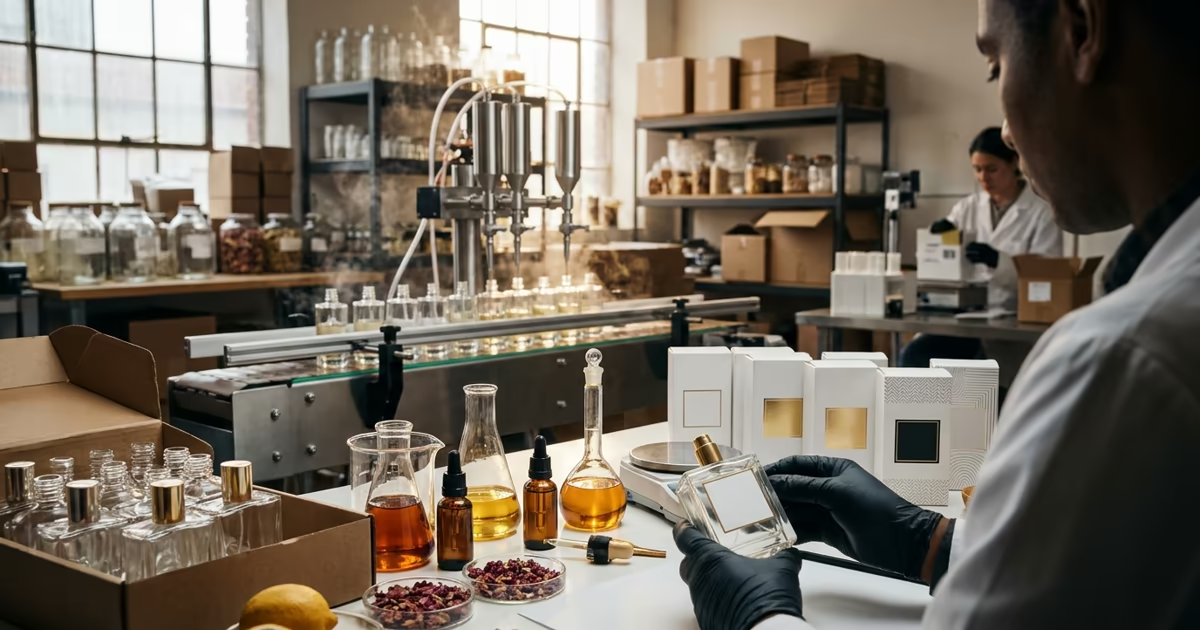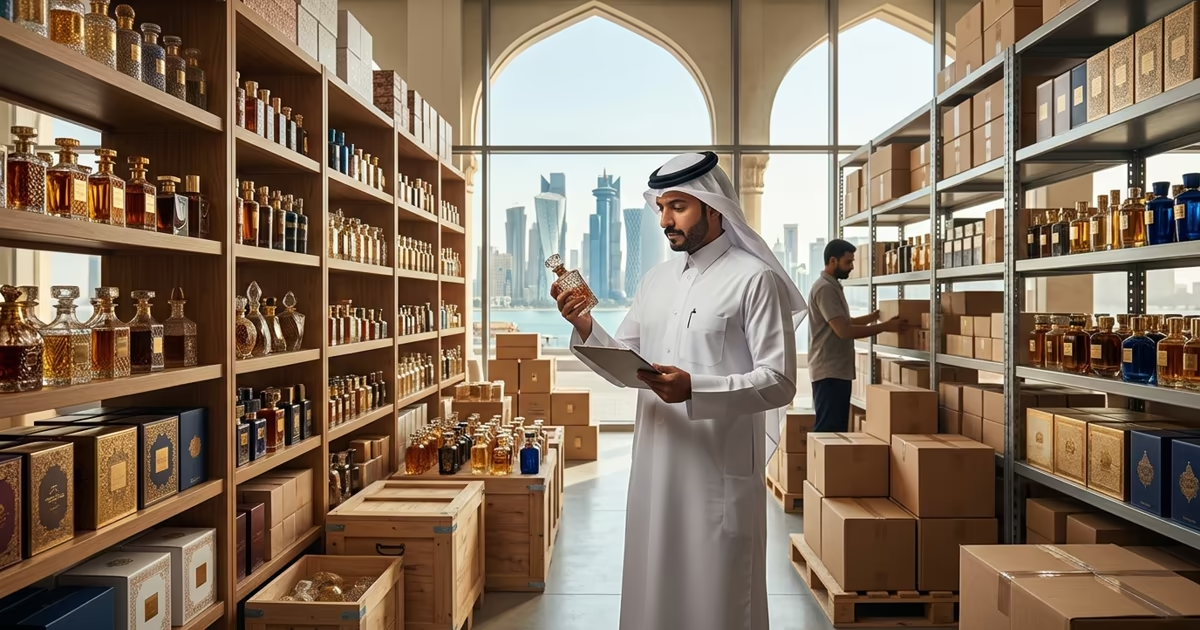
Arabian perfumery is a craft with its own vocabulary, and the difference between the terms is not marketing — it describes genuinely different products made in genuinely different ways. It is the craft Teeb Al Masharib has practised in Qatar since 2019, in our own Doha production.
Oud: the resin, the wood and the oil
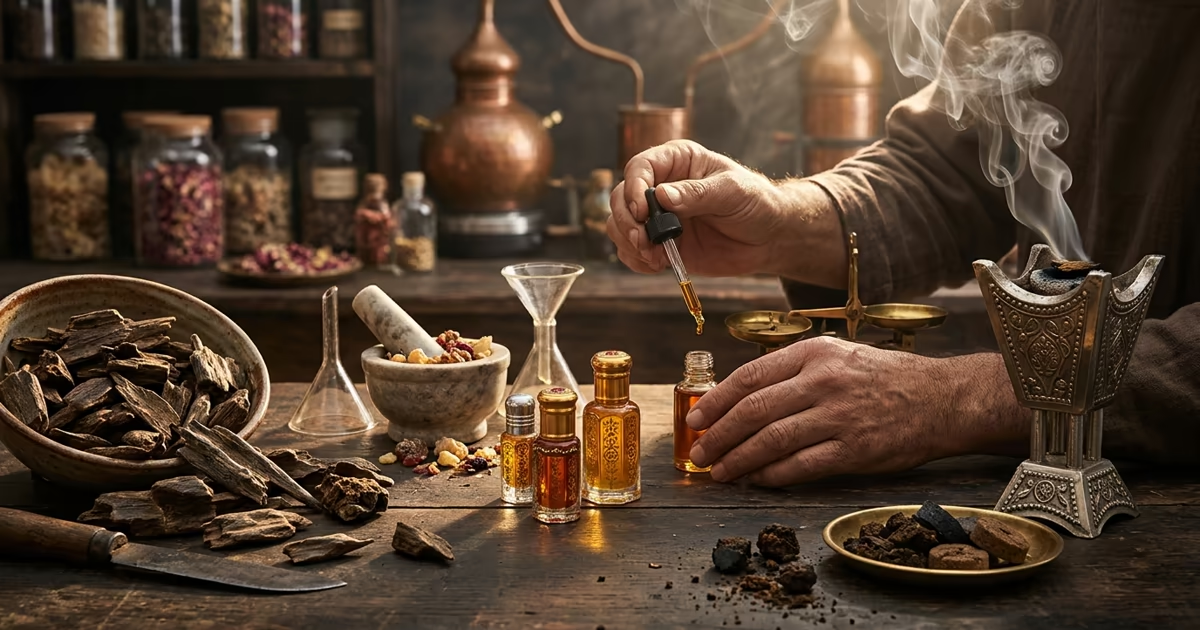
Oud is agarwood resin — resinous heartwood formed inside Aquilaria trees. It is used in three ways: as a piece of scented wood, as chips, and as a distilled oil. The price reflects scarcity, the long years required for resin to form, and the fact that the same tree produces different quality wood depending on soil, climate and how the tree was treated.
In a finished fragrance, oud is rarely used alone. It is the base note that gives depth, fixity and a trail that others cannot fake.
Attar: perfume oil, alcohol-free
Attar is a perfume oil blended from natural ingredients without added alcohol. Because alcohol is what makes fragrance evaporate quickly on skin, an attar stays closer to the body and lasts far longer — typically six to eight hours. It is also more concentrated, which is why a single application is enough and why attar is decanted rather than sprayed.
In the Gulf, attar has deep cultural roots. It is applied to the pulse points, dabbed behind the ear, and often used as a personal scent rather than a room-filling spray. Rose, saffron, musk, oud and amber are the classic attar profiles.
Bakhoor: oud chips, blended for burning
Bakhoor is oud chips — small pieces of agarwood — blended with aromatic resins, oils and sometimes dried floral material, then used over a burner (mabkhara). It is the traditional way oud has been enjoyed in the region for centuries, and the reason bakhoor is one of the strongest gifting formats in the market.
Musk, amber and incense
White musk is the clean, skin-like base that most modern Arabic compositions are built on. Amber (benzoin and labdanum) adds warmth and sweetness. Incense lines — bukhoor, masaleeq, oud chips — sit alongside them as home fragrance rather than personal fragrance.
How the fragrance is actually made
- 01Brief — target price, format, market and scent direction are agreed first.
- 02Composition — materials are weighed into the formula: naturals, synthetics and accords.
- 03Maceration — the blended formula rests, usually for weeks, so the ingredients marry.
- 04Cold maturation — the rested formula is held at low temperature to stabilise the note structure.
- 05Filtration — the fragrance is filtered to remove any sediment.
- 06Filling — the fragrance is filled into the bottle, capped, tested and packed.
We do all of this in our own Doha production. Controlling maceration and maturation in-house is what lets us quote a lead time we can actually hit.
Why the Gulf climate changes everything
Heat and humidity slow the evaporation of the top notes and keep the base notes closer to the skin. The practical effect is that a fragrance in Doha outlasts the same fragrance in a cooler climate — often by an hour or more. It also means heavier concentrations work better, and that testers should be judged on skin after ten minutes, not from the blotter.
Never judge an attar from the bottle. Decant a single application and wear it for an hour — that is the only honest test.
Made this way, in Doha
This is not theory for us. Teeb Al Masharib has made oud, attar and bakhoor in Qatar since 2019, in our own Doha production, where maceration, maturation and filling happen under one roof. Our attars are alcohol-free and wear for six to eight hours, even in Gulf heat. The honest way to judge any of them is on skin — every one of our seven stores across Qatar will decant a single application so you can wear it before you decide.
Frequently asked questions
- What is the difference between oud, attar and perfume oil?
- Oud is agarwood resin — the most expensive natural fragrance ingredient in the world — used as wood, chips or distilled oil. Attar is an alcohol-free perfume oil blended from natural ingredients, which makes it slow to fade and highly concentrated. Perfume oil is the more commercial, alcohol-based equivalent that is easier to spray and more everyday in use.
- Why does a perfume smell different after a few weeks?
- Because fragrance ingredients continue to marry during maceration, the period after blending when the formula rests and settles. A perfume that smells excellent on day one can behave very differently after six weeks in the bottle. Professional evaluation always happens on a rested sample.
- How long do Arabian perfumes last?
- Attar and oud oil typically last six to eight hours and improve as they sit on skin. Eau de parfum sprays last roughly four to six hours, and oud-based sprays are the longest-wearing of our range. In Gulf humidity, fragrance generally lasts a little longer than in drier climates.
- Where can I buy Teeb Al Masharib perfumes?
- Direct from Teeb Al Masharib — at any of our seven stores in Qatar, or through our online shop.